A Share of the Intelligence
Four essays diagnosed one wound: the people who make medicine's intelligence — physicians and patients — hold no claim on it. The cure is not to stop the machine or to sue it one case at a time. It is to build the creators a stake, out of parts that already exist.
I. One wound, named once
Four essays, and a single finding underneath them.
The ambient scribe gave physicians their evenings back, and the value those minutes unlocked was booked by the institution as coding revenue. The conversation itself — the patient’s words, the physician’s reasoning — was captured at the source and, once de-identified, carried out of the privacy law entirely, to train a model no one in the room would own. That model became an asset valued in the billions, extended into coding and revenue cycle, and sold back to the physician’s employer as a subscription. And the record itself — the plainest asset of all — stayed in the employer’s custody, reachable by its author only through a door the law leaves open but no one is required to hold.
Strip away the particulars and it is one wound. The people who generate medicine’s intelligence — the physician’s judgment, the patient’s disclosure — hold no claim on what it becomes. The value flows one way, to whoever owns the infrastructure that captures it, which is never the two people at the center of the encounter.
This essay is about the other direction. Not another diagnosis — a repair. And the argument is narrower and more hopeful than the four essays might lead you to expect: a stake for the creators is buildable, from parts that already exist, and what is missing is not a technology or even a new idea, but coordination and a change in a few laws.
II. What a stake is not
Clear away the false cures first, because they absorb the energy a real one needs.
A stake is not the end of the tools. The scribe genuinely helps; the models genuinely improve; a physician who wants their evenings back is right to take them. Every essay in this series conceded the good faith of the benefit, and the concession was not a courtesy — it was the point. The problem was never that the intelligence exists. It was who ends up owning it.
A stake is not nostalgia, either — a wish to return to paper and the solo practice. That world is gone and was not better on this axis; it simply hid the capture rather than performing it at scale.
And a stake is not won one lawsuit at a time. When an individual patient sued over the disclosure of de-identified records to a technology company, the federal courts turned the case away for lack of a concrete injury — the Seventh Circuit affirmed the dismissal in 2023 (Dinerstein v. Google, No. 20-3134). The individual, standing alone, is the wrong unit. The harm is diffuse, the injury hard to name, and the person with the clearest interest — the physician or patient who made the data — has the least leverage to act. What follows from that is not despair. It is the recognition that the answer has to be collective and structural, not personal and case-by-case.
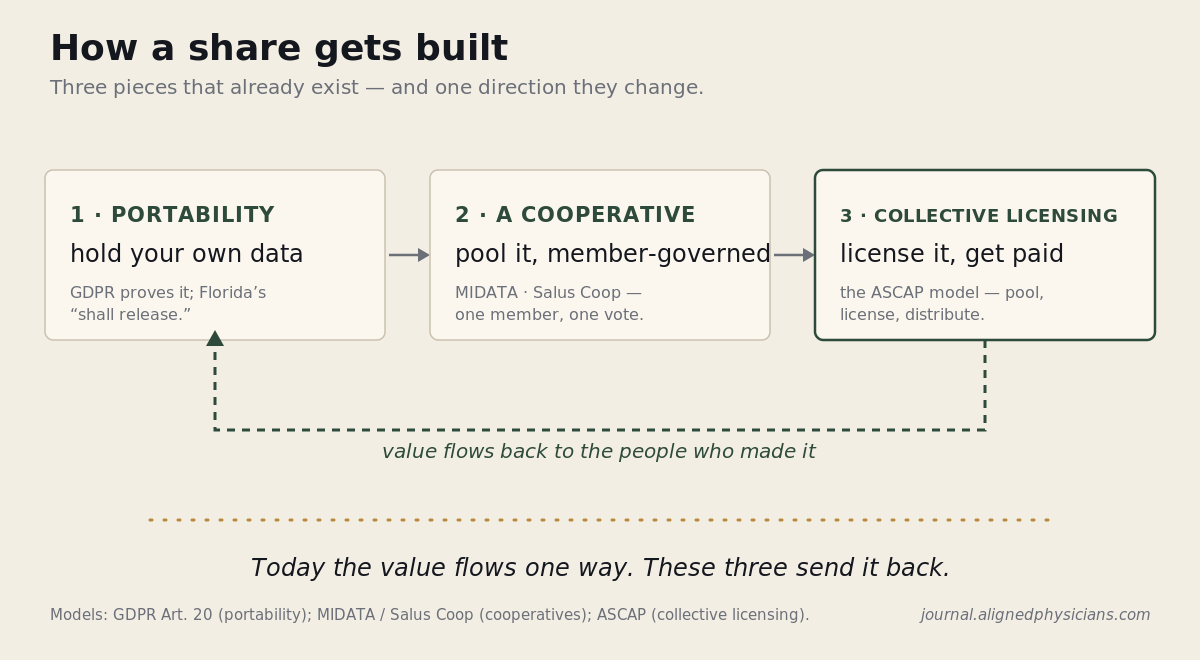
Three pieces, each of which already exists somewhere, compose it: a way to hold your own data, a way to pool it under the creators’ control, and a way to license the pool so value returns. Portability, a cooperative, and a collecting society.
III. Portability: the floor
You cannot own what you cannot hold, and today the physician cannot reliably hold even the record of their own work. So the floor — the smallest, least radical step — is portable access to one’s own data.
Europe has already written this into law. Under the General Data Protection Regulation’s right to data portability, an individual may obtain the personal data a company holds about them in a structured, machine-readable form, and move it to another provider. It is not exotic and it is not theoretical; it has been in force across the European Union since 2018. The United States has no equivalent. HIPAA grants a right to a copy of one’s record, not a right of portability — the word “portability” in the statute’s own name refers to health insurance, not health information — and the interoperability rules that require patient-access data interfaces stop well short of a durable right to carry one’s data wherever one goes.
For the physician, the domestic seed of this already exists, and the previous essay found it: Florida requires a records owner to release to a departing physician the records they personally created. A national version of that — extended, made portable, wired to the interoperability rails the government has already built — is not a leap. It is the floor beneath everything that follows, because a stake in a pooled corpus is meaningless if you cannot first get your own contribution out of the building.
IV. The cooperative: the corpus, under the creators’ control
One physician’s data is a drop; the value the vendors capture lives in the pool. So the second piece is a pool the creators own — a data cooperative.
This is not a thought experiment. Health-data cooperatives already operate. In Switzerland, MIDATA is a member-governed cooperative in which individuals hold their health data in an account and decide, case by case, which research may use it; the members, one vote each, control the cooperative itself, and its surplus is reinvested rather than extracted. In Spain, Salus Coop built a citizen health-data cooperative on the premise that people should be able to contribute their data to research on terms they set. The model is real, and its governance is the whole point: the people who generate the data decide what is done with it.
The American attempts are instructive precisely because they have struggled. A patient-owned cooperative that paid members for the use of their health insight has since abandoned the cooperative framing; a venture that issued patients literal ownership shares in exchange for their genomic data shut down in early 2024. The appetite is real; so is the fragility of a cooperative that must survive in a market built to route around it. That fragility is not an argument against the model. It is an argument for the support — legal and financial — that would let one hold.
Picture the medical version. A cooperative, governed one member one vote by the physicians and patients who generate clinical data, that holds the corpus the vendors now assemble unilaterally — the encounters, the notes, the corrections that make the models good. Not to hoard it. To hold it, on terms its members set, so that the next question — who may use it, and on what return — is answered by the people who made it rather than to them.
V. The collecting society: how the value returns
A cooperative that holds a corpus still needs a mechanism to license it and route the proceeds back, and here the template is a century old and hiding in a different industry.
When a café plays music, it does not negotiate with ten thousand songwriters. It buys a blanket license from a performing-rights organization — ASCAP, BMI — which pools the rights of hundreds of thousands of creators, licenses the whole repertoire at once, and distributes the royalties back to the members after its costs. The individual songwriter, who could never police every café in the country, is paid because the collective does it for them. It is collective licensing, and it has funded creative work for a hundred years under rules that keep it fair.
There is no reason in principle a clinical-data collective could not work the same way. A cooperative holding a governed corpus could license access to the model-builders under standard terms and return the proceeds to its members — the physicians and patients whose encounters compose it — the way a collecting society returns royalties to songwriters. The economist’s name for the underlying idea is “data as labor”: that the data people generate in the course of their lives is not exhaust to be scavenged but work to be bargained for and paid. A governor of California proposed a “data dividend” on exactly that premise in 2019 — that a person’s data has value that belongs to them. The proposal went nowhere. The idea did not.
VI. The obstacle is law, not technology
If the pieces exist, why has none of it happened? The honest answer is that the hardest barrier is not technical. It is legal, and it runs in exactly the wrong direction.
Pooling data among competitors — which is what a cooperative of independent physicians is — raises antitrust questions, and for a long time the government answered them helpfully. A set of 1996 federal enforcement statements drew a “safety zone” telling providers exactly how to exchange aggregated information without inviting prosecution: use a neutral third party, keep the data old enough and pooled across enough participants that no one’s figures could be reverse-engineered. Follow the recipe and you were safe. It was, in effect, a legal on-ramp for the very kind of collective a stake would require.
In 2023 the antitrust agencies withdrew those statements, citing, among other things, that the old guidance had been too permissive about information sharing. Whatever the merits for the mergers the withdrawal was aimed at, its effect on the small, cooperative kind of sharing is to remove the map — to replace a clear safe harbor with case-by-case uncertainty, which, for a fledgling physician cooperative without a law firm on retainer, is indistinguishable from a prohibition. The compensation series closed on this same withdrawn safety zone, because it is the same lever: the legal certainty that would let physicians pool their pay is the legal certainty that would let them pool their data.
So part of the repair is a statute — a safe harbor, written this time for creator-governed data collectives, that says in plain terms how physicians and patients may pool and license clinical data without antitrust jeopardy. And part of it is the other lever this series has named: the de-identification switch. The same provision that lets a vendor carry the corpus out of the privacy law could be conditioned — de-identify all you like, but the residual value returns, in part, to a collective of the people who generated it. The switch that now empties the room could be wired to pay it back.
VII. The collective is already assembling
None of this requires physicians to organize from nothing, because they are already organizing.
Physician unionization, dormant for a generation, has turned sharply upward: by one analysis in a major medical journal, the annual rate of union-petition filings by physicians rose more than tenfold between the early-2020s baseline and 2023–2024, and the largest resident-physician union roughly doubled its membership in five years. The immediate fuel is pay, workload, and working conditions — but the collective muscle a data stake requires is the same muscle, and a bargaining unit that can negotiate over compensation can negotiate over the corpus its members’ work creates. The infrastructure of collective action is being built for other reasons, and it is the infrastructure a stake would use.
The steelman deserves its place here, at the end, because it is strong. The single custodian, the de-identified research pool, the vendor’s aggregated corpus — these produce real public goods. A model trained on millions of encounters helps the next patient; a research database stripped of identity has cured and will cure real disease. A stake for the creators does not have to end any of that, and the version of this argument that tried to would deserve to lose. The claim is only that producing a public good and capturing all of its value are two different things, and that the second does not follow from the first. The corpus can be built and the people who built it can hold a share. Those are not in conflict. They have simply never been arranged together, because no one with the power to arrange them had the incentive.
VIII. Whose intelligence
So, at the end, the question the series was named for.
Whose intelligence is it? It is the physicians’ and the patients’ — assembled, encounter by encounter, out of judgment offered and trust extended, and then, at the moment it becomes valuable, quietly reassigned to whoever owned the machine that recorded it. That reassignment has felt like a law of nature through four essays. It is not one. It is an arrangement, and arrangements can be rebuilt.
The rebuild does not require stopping the intelligence, or inventing a technology, or waiting for a vendor’s conscience. It requires three things that already exist somewhere in the world — a right to carry your own data, a cooperative to pool it under your control, a collecting society to license it and pay you back — and two changes in law to let them operate here: a portability right with teeth, and a safe harbor for the collectives that would hold the pool. None of that is utopian. All of it is assembled, today, in other industries and other countries, by people with far less at stake than a profession that generates the most valuable training data on earth and has, so far, given it away.
The intelligence was always yours. The only question the series ever asked was whether you would hold a share of it — and that one, unlike the others, is still open.
Satyanarayan Hegde, MD, is a pediatric pulmonologist and the founder of Access Pediatric.
The author is not an attorney, and nothing in this article is legal advice. Readers must consult their attorney for legal questions.