Sold Back to You
Microsoft's chief executive has argued that using AI means paying twice — once in money, once in the knowledge you must surrender to make it work. He is right. In medicine, the people who surrender the knowledge are not the ones who signed the contract.
I. The paradox, named by the seller
Earlier this month the chief executive of Microsoft published a short essay that describes, with more precision than any critic has managed, the thing this series has spent two essays documenting.
Satya Nadella begins with Kenneth Arrow, who observed that information is a strange commodity to sell: “Its value for the purchaser is not known until he has the information, but then he has in effect acquired it without cost.” The seller’s dilemma. Artificial intelligence, Nadella argues, inverts it. “In the AI age, the buyer risks giving away knowledge, just in order to use what they bought.”
His formulation of the price is exact:
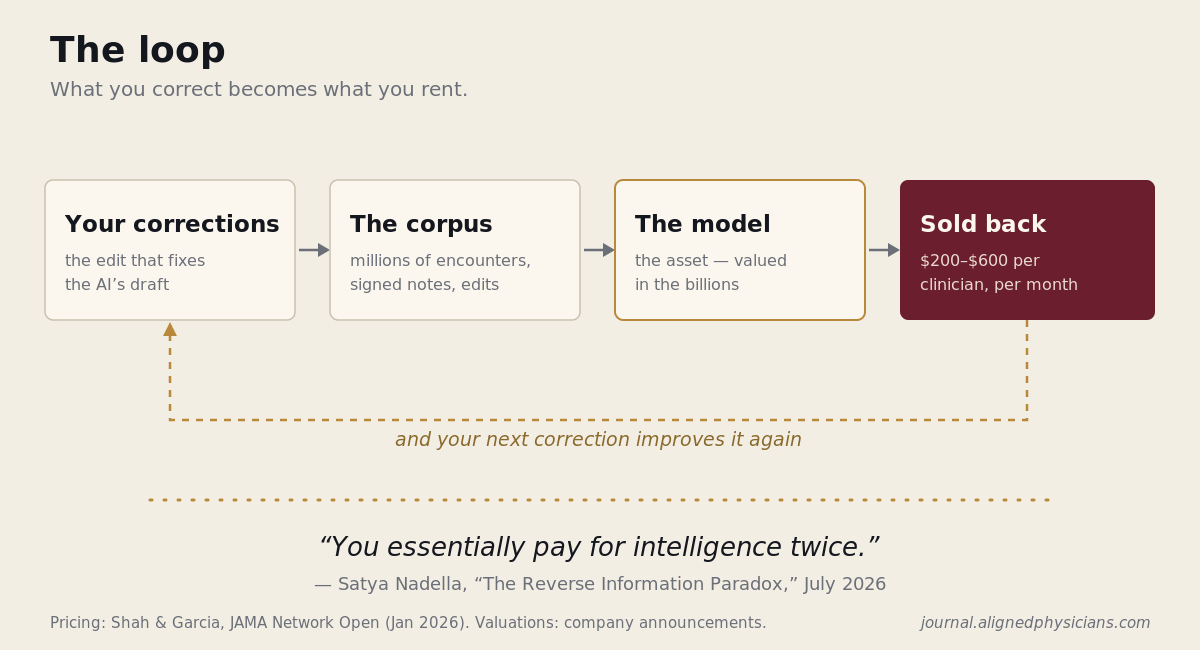
You essentially pay for intelligence twice, once with money, and again with something even more valuable: the proprietary knowledge you must reveal to make that intelligence useful.
And it compounds. “The seller learns more and more about you as you use what you purchased, while you learn very little about what the seller is learning in return.”
Then the passage that should stop any physician who has ever fixed an AI-drafted note. Models, he writes, learn from “exhaust” — the prompts, the tool calls, “and especially the corrections people make when the model is wrong.” Every correction “is distilled into institutional know-how. It’s the kind of knowledge a competitor could never buy, and the kind that leaks almost imperceptibly: trace by trace, correction by correction, eval by eval.”
He is not describing a hypothetical. And he is not, to be clear, defending the arrangement. His conclusion is that “in consuming intelligence, you are creating intelligence. And what you create should belong to you” — followed by five principles for keeping it: Control of your evals and your organizational memory; Capability to train inside your own tenant boundary; Choice of model; Cost discipline; and Compounding, the learning loop that accrues to you. He wants a “hard boundary across which nothing crosses, not even the intelligence exhaust, without consent.”
I agree with all of it. The essay is a more honest account of the AI economy than most of what is written by people paid to criticize it. The question this essay asks is narrower, and it is not whether he is right. It is where he has drawn the boundary, and who is standing outside it.
II. Who is the buyer?
Every remedy in that essay is addressed to a firm. Read it again with medicine in mind and the trouble surfaces immediately: in the exam room, who is the buyer?
The health system is. The system evaluates the vendors, signs the enterprise agreement, negotiates the data terms, and pays the invoice. The system is the party with a tenant boundary, a procurement office, and the leverage to demand any of Nadella’s five principles.
The physician is not the buyer. Neither is the patient. They are the two parties who supply the thing he identifies as the second, larger payment — the proprietary knowledge — and they are not party to the contract in which it changes hands. In the framework of the essay, the clinician does not appear as the firm protecting its know-how. The clinician appears as the source of the exhaust.
That is the whole of what follows. Take Nadella’s argument as true, because it is, and simply ask what happens to it one level down.
III. Your corrections are the product
Start with the specific thing he says leaks most valuably, because in clinical AI it is not an inference. It is published.
Microsoft’s own privacy white paper for Dragon Copilot — the ambient scribe built on the Nuance technology Microsoft acquired — describes the pipeline plainly. The tool streams the encounter audio, generates a transcript, drafts the note. And then: “As the clinician edits and signs off on the clinical documentation, Microsoft also collects these changes and the resulting signed documentation.” Selected customer data is moved to a research environment, anonymized within 90 days, and the document states that the models “are trained solely on anonymized data,” with human annotators assisting “with the creation of anonymized data sets used for model improvement.”
Set that beside the essay. The corrections people make when the model is wrong are, in the chief executive’s own account, the most valuable and least visible thing a customer gives away. In the clinical product, those corrections are collected by design — and the person making them is not the customer.
The pattern is not Microsoft’s alone. Nabla’s help documentation, asked whether feedback is used to train the model or only for troubleshooting, answers: “Both.” Its developer documentation invites customers to “optionally include corrected output,” which “helps us automate user feedback and ensure the API maintains the highest possible quality.” Abridge has written that it monitors “how much clinicians edit, rewrite, or restructure notes” as a signal gating model releases. Suki’s terms reserve the use of customer data for “system tuning, grammar tuning, training of acoustic models and other models.”
None of this is concealed, and none of it is unusual for software. What makes it worth naming is the substance of the correction. When a physician rewrites an AI-drafted assessment, the edit is not a bug report. It is the clinical judgment itself, rendered in the most compact form it ever takes: the difference between what the machine thought the encounter meant and what the doctor knew it meant. That difference is the most concentrated expression of medical expertise ever produced at scale — and it is generated, unpaid and unrecorded as labor, thousands of times a day.
Nadella calls this “your particular intelligence,” invoking Hayek: the knowledge of time, place, and circumstance that no one else can hold. In medicine, the person holding it is not the entity with the trust boundary.
IV. What the corpus builds
Follow the corrections to what they become, and you arrive at an asset.
The scale of the capitalization is public. Abridge, an ambient documentation company deployed across more than a hundred US health systems, announced a Series E in June 2025 led by Andreessen Horowitz that valued it at $5.3 billion — roughly double its $2.75 billion valuation four months earlier. Ambience Healthcare raised $243 million in July 2025 at $1.25 billion. The clinical-reference tool OpenEvidence reached a $12 billion valuation in January 2026, roughly double its October figure, on about $700 million raised. And the foundational transaction of the category was Microsoft’s acquisition of Nuance, announced in April 2021 at $19.7 billion, of which Nadella said at the time: “Nuance provides the AI layer at the healthcare point of delivery.” Microsoft’s announcement noted that Nuance’s solutions were already used by more than 55 percent of US physicians.
These are not valuations of software. Ambient documentation is, technically, a well-understood problem; several vendors solve it competently. What separates them is the corpus — the accumulated encounters, transcripts, signed notes, and corrections that no new entrant can buy. Asked what makes the work defensible, Abridge’s vice president of product put it directly in a May 2026 interview: “when you think about the things that make it hard, it also gives you the moat.”
The moat is the aggregated clinical judgment of the physicians using the product.
V. Up the value chain
An asset built inside the documentation workflow does not stay in the documentation workflow.
Abridge’s own revenue-cycle page describes the ambition without euphemism: to “close revenue cycle gaps at the point of care,” turning “every clinician-patient conversation into audit-ready, billable AI documentation—instantly.” The company became the first “Pal” in Epic’s Partners and Pals program, embedding it in the record system where the work already happens. Microsoft’s Dragon Copilot has expanded from drafting notes to capturing “over a dozen order types” during the conversation and drafting referral letters from it, with coding support across ICD-10, HCC, and E/M. Ambience advertises roughly $13,000 per clinician per year “via enhanced HCC and greater E/M coding accuracy” in a validated health-system case study. Suki reports level-4 visits rising 3.8 percent, for “an estimated average net gain of $379 per clinician per month after subscription costs.”
The trajectory runs from writing the note, to coding the note, to pricing the encounter, to sitting inside the record system as the layer through which clinical work is documented, billed, and audited. Each step is trained on the corrections of the clinicians who came before, and each step moves closer to the judgment that was supposed to be the physician’s contribution.
VI. And then it is sold back
Here the loop closes.
The tool built from clinical conversation and clinical correction is sold to the institution as a subscription. A January 2026 analysis in JAMA Network Open found that “AI scribes remain costly, with most health systems paying subscription fees of $200 to $600 per clinician per month.” No major vendor publishes list pricing, which is itself a fact worth noticing in a market that asks physicians to trust it with the contents of the exam room.
At that price the arithmetic decides who gets the tool. A physician in a three-provider rural Wisconsin practice, quoted in Medical Economics, explained why hers went without: “$1,500 a month is a lot for a practice of my size, so we elected to hold off.” A Kaiser Permanente physician executive named the emerging split more bluntly: “The AI ‘have-nots’ will be health systems like county hospitals, federally qualified health centers, and rural hospitals that lack the infrastructure or expertise…” The corpus is built from encounters everywhere; the product returns to the places that can afford the subscription.
And the return on that subscription is, by the most careful independent assessment, unsettled. The Peterson Health Technology Institute, whose report observes that “there is no technology in recent memory that has been adopted more enthusiastically by clinicians or has scaled so uncharacteristically fast, absent a regulatory mandate,” concluded that the financial impact remains unclear — warning of “a real risk that as ambient scribe adoption continues apace, health systems will implement solutions in ways that add to overall costs of care.” The wellbeing benefit is real, as the first essay in this series argued at length. The financial case is not yet proven, and the price is certain.
So: the physician supplies the conversation. The physician supplies the corrections that make the model good. The corpus becomes an asset valued in the billions. The asset is sold back to the physician’s employer at several hundred dollars a month per physician — and the physician, who is not the buyer, receives neither the tool’s revenue nor a share of the thing their judgment built.
VII. What comes next, stated as what it is
Two developments are worth naming carefully, because the temptation to overstate them is strong and the evidence does not support it.
The first is deskilling. In August 2025, The Lancet Gastroenterology & Hepatology published a study that an accompanying Comment called “the first real-world clinical evidence for the phenomenon of deskilling”: among nineteen experienced endoscopists at four Polish centers, the adenoma detection rate in colonoscopies performed without AI assistance fell from 28.4 percent to 22.4 percent after the physicians had been routinely exposed to AI assistance. The finding is narrow — observational, one country, nineteen endoscopists, a single outcome measure — and it is not a general proof that clinical AI erodes clinical skill. It is one careful study, and it points in a direction that anyone building a model out of physician corrections should want to understand before the corrections stop being expert.
The second is that the same class of technology is being turned around to audit the work. Under a Medicare model that began taking prior-authorization requests in January 2026 across six states, AI is used to screen physician orders for review. A KFF analysis this year, reporting survey data from the National Association of Insurance Commissioners, put the share of responding insurers using AI or machine learning in utilization management at 84 percent; the AMA has found that 61 percent of physicians are concerned that health plans’ use of AI is increasing prior-authorization denials. The intelligence assembled from clinical judgment is beginning to appear on the other side of the table from the clinician.
What is not established — and I will not claim it — is displacement. The peer-reviewed literature through early 2026 continues to conclude that AI will augment rather than replace physicians on any horizon it is willing to forecast. The honest statement is narrower and sufficient: the asset is compounding, it is moving toward the judgment, and the people generating it hold no position in it.
VIII. The boundary, redrawn
Return to the five principles, and apply them to a working doctor.
Control — private evals, ownership of your organization’s memory, traces, and feedback. The physician has no evals, and the traces are the vendor’s. Capability — train inside your own tenant boundary. There is no physician tenant. Choice — decouple from any single model, so that losing one does not cost you your capability. The physician did not choose the model and cannot change it; the system did. Cost — optimize your spend. The physician does not hold the contract, and where they do, it is $200 to $600 a month. Compounding — the continuous learning loop that makes your investment accrue to you. It accrues, precisely as designed, to the owner of the learning infrastructure.
Nadella’s own sentence anticipates the result: “If learning flows in only one direction, economic value converges toward the owners of the learning infrastructure rather than the creators of the knowledge itself.” He wrote it about enterprises. It describes the position of every physician using an ambient scribe with more accuracy than it describes any hospital.
The steelman deserves its full weight here, because there is one. The vendors are not stealing; they are building genuinely useful tools, disclosed in terms anyone may read. The corrections really do make the model better, and a better model helps the next patient — which is not nothing, and is arguably the point of medicine. And Nadella is not defending the asymmetry; he is arguing that learning infrastructure should be distributed so that firms can keep what they create. That is a constructive position, and a more generous one than the industry’s norm.
The argument here is only that his principle, taken seriously, does not stop where he stopped it. If what you create should belong to you, then the question is why the trust boundary is drawn around the enterprise and not around the people whose particular intelligence is the thing being distilled. A hospital can demand a tenant boundary. A physician cannot demand anything, because the physician is not at the table — and neither is the patient whose words began the whole sequence.
There is a further custody problem sitting underneath this one, and it belongs to a different owner. Even the clinical record a physician creates with their own hands is held by the employer, on terms the physician does not set and often cannot see. That is the subject of the next essay.
For this one, the question to carry out of the room is the one Nadella asked on behalf of companies, asked instead on behalf of the person holding the stethoscope: you are creating intelligence in the act of consuming it — so what, exactly, would it take for a share of what you built to belong to you?
Satyanarayan Hegde, MD, is a pediatric pulmonologist and the founder of Access Pediatric.