The Dollar That Never Arrives
Medicaid spending on care has ballooned and pediatric pay has not. The money is real — it is routed through a financing machine, built in plain sight, that lodges it almost everywhere except the bedside.
I. The dollar that never arrives
An earlier essay in this series ended on a question it deferred: where do the institutional dollars come from, and where do they go? This one answers it, and the answer is stranger than the underpayment it explains.
Start with a paradox a working pediatrician can feel without any data at all. We are told, every budget cycle, that Medicaid is straining — that spending is up, that the program is unsustainable, that cuts are coming. And we are told, in the same breath, that there is no money to raise the fee schedule. Both cannot be the simple truth. If the program spends more every year and the rate a clinician is paid for a visit has barely moved since 2008, then the additional money is real and it is going somewhere — just not into the column with the clinician’s name on it.
It is going into a financing apparatus that sits between the appropriated dollar and the exam room. The apparatus is large, it is growing far faster than any fee schedule, and — this is the part worth sitting with — it is not hidden. Every piece of it is described, measured, and criticized in the published reports of the Government Accountability Office and the Medicaid and CHIP Payment and Access Commission, the federal government’s own auditors and advisors. The machine runs in plain sight. We simply never learned to read its gauges.
This essay traces a single Medicaid dollar through that machine. It is, by design, the most mechanical piece in this series — but the mechanics are the argument. Follow the dollar and the question of pediatric pay stops being a lament about low rates and becomes a question about who built the channels the money runs in, and who they were built to serve.
II. Conjuring the match
The first thing to understand is that states do not simply receive Medicaid money from Washington and spend it. Medicaid is a match: for roughly every dollar a state puts up, the federal government adds between one and three more. So the binding question for a state is not “how much should we spend” but “how do we produce the state share that unlocks the federal share” — and here the engineering begins.
The orthodox way to raise the state share is general tax revenue. But there is a more ingenious way, and nearly every state now uses it. A state levies a tax on health care providers — hospitals, nursing homes, managed-care plans — uses the proceeds as its share of a Medicaid payment, and then sends that payment back to the same providers, now multiplied by the federal match. The Congressional Research Service describes the result without euphemism: the maneuver “allows states to fund increases to Medicaid payment rates without the use of state general funds.”
The numbers make it concrete. CRS works a current example: a state levies a $10 million tax on nursing facilities, pays $8 million of it back to them as enhanced Medicaid payments, draws $4.8 million in federal match on that payment, and is “left with $6.8 million to use for other Medicaid or non-Medicaid purposes.” The providers, taxed and then repaid, come out close to whole; the state spends little or nothing of its own; the federal government covers the difference. The Government Accountability Office has described the same loop, in report after report since 1994, as funds that make “a round-trip from the states to providers and back to the states.” Its first study of the practice, in 1994, was titled — in the GAO’s own measured institutional voice — Medicaid: States Use Illusory Approaches to Shift Program Costs to the Federal Government.
How is this permitted? Federal law allows provider taxes as long as they are broad-based, uniform, and do not “hold providers harmless” — and it then defines a safe harbor that swallows much of the rule: a tax set at 6 percent or less of a provider’s net patient revenue is presumed acceptable. As of 2025, forty-nine states and the District of Columbia — every state but Alaska — levy at least one such tax. The aggregate effect is measurable. MACPAC estimates that once you net out the dollars providers and local governments “contributed and received back,” the effective federal share of Medicaid rose from 62.6 to 68.0 percent in a single recent year — more than five points above the rate Congress wrote into law. None of that increment buys a single additional unit of care. It is the yield of the machinery itself.
III. The institutional catch-basin
A drawn-down dollar has to land somewhere, and the law channels it into payments that attach to institutions, not to the clinicians who do the work.
There are three main basins. Disproportionate-share (DSH) payments flow to hospitals that serve many low-income patients, computed against each hospital’s own uncompensated-care cost. Upper-payment-limit (UPL) payments fill the gap between ordinary Medicaid rates and what Medicare would have paid — but, crucially, they are calculated for a “class of providers, in the aggregate,” never claim by claim or clinician by clinician. And state directed payments (SDPs), the newest and fastest-growing channel, let a state instruct its managed-care plans to route extra money to chosen providers. Together, supplemental payments of this kind reached about 36 percent of fee-for-service payments — $56 billion — for hospitals, nursing facilities, and physicians in 2022.
The trajectory of the directed-payment channel is the tell. MACPAC’s own series tracks approved SDP spending from roughly $24.7 billion (arrangements approved through 2020) to $69.3 billion (early 2023) to a projected $110.2 billion a year as of August 2024 — very nearly a tripling in four years. And the money is overwhelmingly institutional: of the largest arrangements, each projected above a billion dollars a year and together about seventy percent of all SDP spending, the great majority are targeted to hospital systems and financed by the very provider taxes and transfers described above.
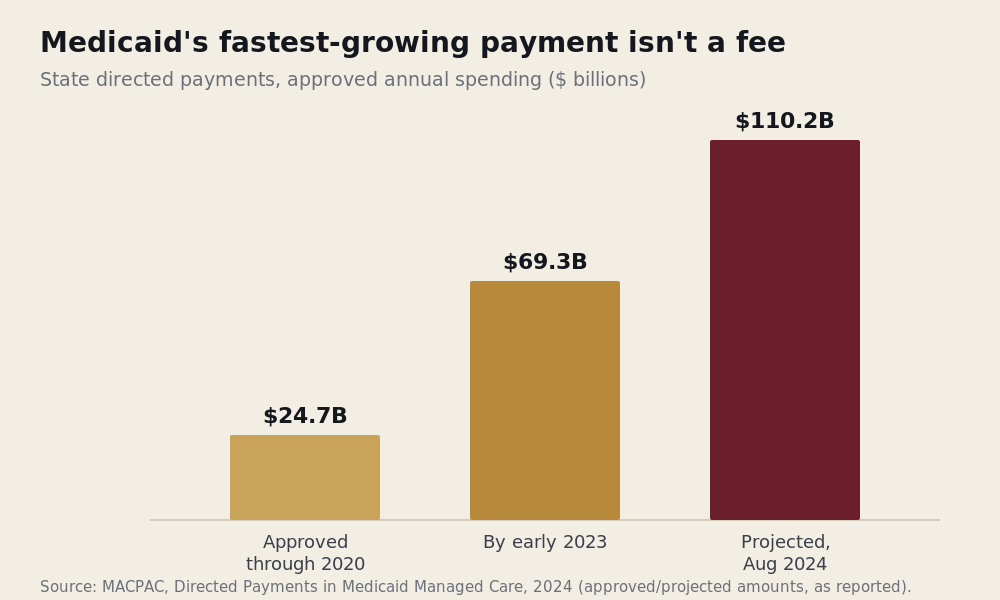
This is where an earlier essay’s argument reappears as plumbing. That piece showed that an academic physician’s parity arrives through channels that “never resolve into a per-service rate.” These are those channels. DSH is a hospital-level offset; UPL is an aggregate-class ceiling; SDPs are routed to systems. Not one of them is a fee the treating clinician can look up, bill against, or carry to a negotiation. The money grew threefold in four years and remained, at every step, addressed to the institution.
IV. The middle men
Most Medicaid no longer flows as fee-for-service at all. About 78 percent of enrollees are now in private managed-care organizations paid a fixed sum per member per month, and roughly half of all Medicaid dollars pass through them. Inserting a private intermediary between the public dollar and the provider creates a layer that, by design, keeps a share.
What it may keep is capped, in principle, by a medical-loss-ratio rule: a plan is expected to spend at least 85 percent of its revenue on care, leaving about fifteen for administration and profit. Honesty requires the counter-evidence here, because it is real: the HHS Office of Inspector General found that roughly 92 percent of Medicaid managed-care plans met or beat the 85 percent standard. The loss-ratio floor is not a fiction. But a floor on the plan’s margin says nothing about the layers beneath it — and that is where the clearest extraction has been documented.
Consider the pharmacy benefit manager, the firm a plan hires to administer drug coverage. PBMs can practice “spread pricing”: billing the plan more for a drug than they pay the pharmacy, and pocketing the difference. When the Ohio Auditor of State examined one year of its Medicaid managed-care pharmacy data, it found PBMs had taken $224.8 million in spread — and on generic drugs specifically, they kept 31.4 cents of every dollar the plans paid. The state had not known; it took an audit to surface it. Ohio ordered the practice ended. The mechanism is not unique to Ohio; it is simply where someone counted.
Beneath the plans and the PBMs sits a further, harder-to-see layer: the management-services organization, the non-clinical company that increasingly owns the billing, the contracts, and the operations of physician practices and takes a management fee — often a percentage of revenue — for the service. Here the public record genuinely thins out; there is no government tally of what MSOs extract from Medicaid-funded practice revenue, and I will not invent one. But the structural point survives the data gap: each additional intermediary between the appropriated dollar and the clinician is a place the dollar can be made to pause, and to shrink.
V. Hiding in plain sight
It would be easy to narrate all of this as a hidden scandal. It is the opposite, and the distinction matters. Every mechanism above is documented by the institutions charged with overseeing the program. GAO has called provider-tax financing a cost-shift to the federal government for thirty years and, in 2020, found that CMS’s own data on the sources of the state share were “not complete, consistent, or sufficiently documented” — the overseer cannot fully see the machine either. MACPAC publishes the effective-federal-share arithmetic. The Ohio spread was found by a state auditor and published. The conflicts are not concealed; they are disclosed, in tables, by the government.
The sharpest confirmation that the apparatus is real and large came in 2025, when Congress moved to dismantle parts of it. The budget reconciliation law enacted that July (Public Law 119-21 — the popular “Big Beautiful Bill” name was struck from the statute and carries no legal force) froze new provider taxes nationwide, ratcheted the 6 percent safe harbor down toward 3.5 percent for expansion states, and capped directed payments near Medicare rates. The Congressional Budget Office scored the provider-tax provision alone at $191 billion in reduced federal Medicaid spending over a decade, and the directed-payment cap at another $149 billion. You do not save a third of a trillion dollars by closing a loophole that wasn’t moving real money.
The temptation, having traced the loop, is to reach for the criminal vocabulary — to call a tax-and-rebate cycle that draws down federal billions a kind of laundering, as some critics on the policy right now do. The journal’s discipline is to resist it, for a reason that is also strategic: the mechanics are damning enough on the government’s own neutral record that the accusation adds risk without adding force. And the other side has a serious answer. The American Hospital Association points out that provider taxes have been explicitly authorized by Congress since 1991, reviewed by CMS, and capped by rule — “the opposite of an unregulated workaround.” Describe the machine accurately and let the reader judge; that is both the more honest move and the more durable one.
VI. The hole the machine fills
Here the argument has to turn on itself, because the strongest case against a simple villain story is the one the hospitals make, and it is largely true.
Why does this apparatus exist at all? Because the base rate it works around is genuinely too low. By the hospital industry’s accounting, Medicaid fee-for-service pays less than 58 cents for every dollar of hospital cost, and even after all the supplemental payments are added in, Medicaid still pays below cost — a national hospital shortfall the industry put at $27.5 billion in 2023. MACPAC’s independent figures point the same way: among the hospitals that receive DSH, Medicaid covered about 86 percent of costs before those payments and 95 percent after. The machine, in other words, is not pure extraction. It is the contraption a system built to push an inadequate base rate back toward solvency — and for the safety-net and rural hospitals that depend on it, the 2025 cuts are not housecleaning but a threat to survival.
Grant all of that, and the indictment does not dissolve; it sharpens, and it returns to this series’ through-line. The problem was never that money fails to reach Medicaid providers. It is the form the money takes on the way. A base rate set too low, then patched by an apparatus that is opaque, addressed to institutions rather than clinicians, dependent on financial engineering most physicians have never heard of, and reversible at a single act of Congress — that is not a payment system a working clinician can see, predict, or negotiate against. It is the same finding as the visible-versus-invisible price, one level up: where the system’s money is concerned, the people who generate it are the last to be shown the books.
VII. What an honest accounting would surface
There is a constructive reading here, and it is not a complaint about hospitals. The supplemental apparatus does real work; the base rate it compensates for is a real problem; the people running the machine are mostly following rules Congress wrote. An honest accounting would not begin by tearing it down. It would begin by making it legible — to the clinicians whose work is the reason any of these dollars are appropriated in the first place.
That is a low bar and an unmet one. A pediatric subspecialist cannot today obtain a straight answer to the simplest question about her own labor: of the public money her work draws into the system, how much reaches her, how much lodges in the layers above, and who decided the proportion. The machine’s defenders and its critics agree on the mechanics; they have published them in detail. The one party kept outside the disclosure is the one at the bedside.
That is where this series is headed — not how the money moves, but what a compensation conversation would look like if the person doing the work could finally see the whole of it.
Satyanarayan Hegde, MD, is a pediatric pulmonologist and the founder of Access Pediatric.