If the Books Were Open
Five essays diagnosed the same wound: the physician cannot see what the work is worth. The cure is not a better number — it is a number the physician can see, and owns.
I. The conversation that can’t be honest
Picture the annual review, or the moment before you sign. On one side of the table sits the person who sets your number — a section chief, a department administrator, a recruiter. In front of them is a figure, and behind the figure is a survey: the market rate for someone like you. On your side of the table is nothing comparable. You have a sense, an anecdote from a friend, a half-remembered number from a conference hallway. You can accept the figure or push on it, but you cannot check it, because the only document in the room belongs to the other party.
This is the structure of nearly every compensation conversation a physician has, and it is worth naming what it is: a negotiation in which one side can see the board and the other is told to trust that the board exists. Whatever else is wrong with how doctors are paid, this is the thing under it. Not that the numbers are low — sometimes they are not — but that you are asked to agree to a number you are structurally prevented from verifying.
Essays over the last few weeks have circled that asymmetry from different sides. This last one says the obvious thing plainly: an honest compensation conversation would require that the books be open — and not opened to you, as a courtesy, but held by you, as a right. That is a larger claim than it sounds, and the rest of this piece is an attempt to earn it.
II. The one finding under all five
Read back across the series and the separate arguments collapse into a single one.
The first essay showed that the benchmarks pediatricians negotiate against are produced by the buy side of the labor market — that the “independent” number is manufactured by the parties who pay it. The second showed that what looks like a workforce shortage is a distribution shaped by economics the physician never sees laid out. The third showed that pediatric pay is set by the payer rather than the work, and that where the system patches the gap, it routes the correction through institutional channels that “never resolve into a per-service rate.” The fourth showed that subspecialty scarcity lowers pay instead of raising it, because the labor is sold into a market with one real buyer. The fifth followed the public dollar through a financing apparatus and found, at the end, that “the people who generate it are the last to be shown the books.”
Five diagnoses, one disease. In every case the physician is denied sight of their own economic value — the benchmark is captured, the distribution is opaque, the effective rate is hidden, the buyer is concealed by the appearance of a market, the money is routed where it cannot be traced. The series kept arriving at the same wall from different corridors, and the wall is always made of the same material: information the physician is not permitted to hold.
Name the disease that way and the remedy stops being five different reforms. It becomes one.
III. Why you aren’t shown
The reason is not a conspiracy, and it does not need to be. It is a fact about who owns the data, and it is openly disclosed.
The numbers that actually set physician pay are proprietary, and they are produced by the side that buys the labor. The most-cited compensation survey is published by the Medical Group Management Association — an association whose members are practice administrators and executives, not physicians, and whose figures are employer-reported. The benchmark most closely tied to how large systems design pay comes from SullivanCotter, a compensation-consulting firm, built from data the employing systems submit. The recruiting incentives that frame a new graduate’s first offer are tabulated by a national staffing firm from its own book of search engagements. Each is sold, at a price, mostly to the institutions that pay physicians — so that they may set “fair market value” against a number they themselves supplied.
An economist would call the result a failure of price discovery. A functioning market discovers a price because both sides can see what is being paid; buyers and sellers, transacting in the open, converge on a number that reflects what the thing is worth. A market in which only the buyers can see the prices is not discovering a price. It is administering one. The physician is not a participant in a market so much as the object a market is being conducted upon — and the single fact that makes it so is that the sell side has no books of its own.
IV. What an honest accounting would make visible
Begin with what is dark, because the list is short and specific. A physician cannot reliably see the effective rate their services command after the patches and supplements described earlier in this series — the number their work actually draws into the institution, as opposed to the salary the institution decides to return. They cannot see the spread between what their payer mix yields and what they are paid. They cannot see what the layers above them retain. And they cannot see, in any form they own, what physicians genuinely comparable to them — same specialty, same setting, same region — are actually paid, as opposed to what an employer-funded survey reports in the aggregate.
Hold that against the direction the rest of the economy is moving, because the contrast is the argument. Since January 2021, federal rule has required hospitals to publish their standard charges, including payer-specific negotiated rates, in machine-readable files. Since July 2022, insurers must post their negotiated in-network rates the same way. The No Surprises Act took effect the same year, dragging the most opaque corner of medical billing into a federal arbitration process. And a growing roster of states — Colorado in 2021, California and Washington in 2023, New York that September — now require employers to disclose salary ranges in their job postings.
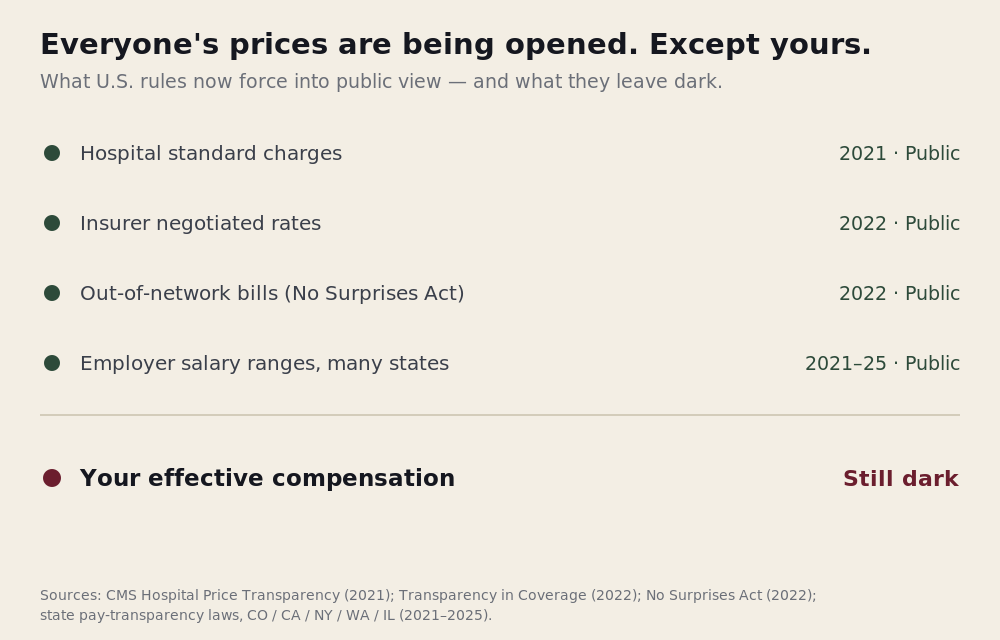
The whole economy, in other words, is being pushed toward the principle that a price you must pay is a price you are entitled to see. Hospital charges, insurer rates, the salary band on a job listing — the trend is unmistakable, and it is bipartisan, and it is accelerating. The physician’s own effective compensation is one of the last large prices in American economic life still kept systematically dark, and the people from whom it is kept are the ones who produce the value being priced.
V. The thing that would have to exist
If the problem is that the sell side has no books, the remedy is that the sell side keeps its own.
What an honest compensation conversation requires, concretely, is a body of compensation data that physicians produce, control, and can pool — not a friendlier survey administered by someone else, but a record owned by the people whose labor it describes. The benchmark would no longer be a number handed across the table; it would be a number the physician brings to it. Price discovery, in the plain economic sense, would for the first time have a sell side that can see.
This is not, at present, something that exists at any scale. The free compensation reports that physicians do see are either corporate media that monetize the audience or venture-funded startups answerable to their investors; the genuinely physician-owned, member-controlled exception is small and fragile. The absence is not an accident of the market. It is the market’s defining feature — the thing the first essay began with, restated as a gap where an institution ought to be.
I will say once, and then leave it, that building exactly this is the premise the network publishing these essays rests on; the point of the series was never to argue for that, and I am not going to start now. The argument stands on its own logic. If the diagnosis across five essays is that physicians cannot see what their work is worth, the implication is not subtle, and it does not require my endorsement: someone the physicians control has to keep the books.
VI. The objections, taken seriously
Three objections are worth meeting head-on, because the first two are answerable and the third is the one that actually bites.
The first is privacy: physicians may not want their individual pay exposed. But individual exposure was never the point, and the established design avoids it. The conventional safeguard is aggregation — figures pooled across enough participants, old enough and anonymized enough, that no single person’s pay is recoverable. The surveys that price physicians already work this way; the difference proposed here is only who holds the aggregate.
The second is free-riding: the physicians who would benefit most from shared data are the least likely to contribute their own. This is real, and it is the ordinary problem of every cooperative good. It is also the kind of problem that institutions exist to solve — through reciprocity, through making contribution the price of access. It is a design challenge, not a refutation.
The third objection is the serious one, and intellectual honesty requires sitting in its discomfort: is it even legal for physicians to share compensation data? For decades the answer had a bright line. A 1996 federal antitrust safety zone told health care providers exactly how to exchange wage and price information without inviting prosecution: have it managed by a neutral third party, use data more than three months old, and aggregate it across at least five participants so no one’s figures could be reverse-engineered. Follow the recipe and you were safe.
That recipe no longer exists. In February 2023 the Department of Justice withdrew those statements, calling them “overly permissive on certain subjects, such as information sharing,” and the Federal Trade Commission followed that July. The agencies replaced the bright line with case-by-case enforcement under the rule of reason and published no successor safe harbor. The map was taken down; no new map was put up. What remains unambiguous is the thing on the other side of the line, and it is now a crime: under guidance the agencies issued in 2016 and have never withdrawn, an agreement among competitors about what to pay — wage-fixing, no-poach — can be prosecuted criminally, “in the same irredeemable way as agreements to fix the prices of goods.”
The distinction is everything, and it is worth stating precisely, because it is the hinge on which a constructive future turns. Agreeing on what to charge or pay is fixing, and it is illegal. Sharing what one has been paid — looking, retrospectively and in the aggregate, at the market that already exists — is transparency, and it was lawful for thirty years under a published recipe. Those are not the same act, and conflating them is precisely the confusion that now serves the buy side. For the practical effect of withdrawing the safety zone without replacing it is not that information-sharing became illegal. It is that it became uncertain — and uncertainty, here, falls almost entirely on the side that would benefit from sharing. The institutions already have their data; they need no safe harbor to keep doing what they do. It is the physicians, contemplating pooling theirs, who must now weigh a legal risk that did not exist three years ago. The map was withdrawn, and the people left without one are the people who never had the books.
(This essay describes a regulatory record; it is not legal advice, and anyone building toward shared compensation data should take counsel who can read the current law against a specific plan.)
VII. What becomes possible
The series set out to diagnose, not to prescribe, and it has mostly kept to that. But a diagnosis carries an implication whether or not the diagnostician likes it, and this one’s is simple enough to state in a sentence. An honest compensation conversation does not require a higher number. It requires that the number be one the physician can see, and check, and hold — that the books, for once, be open on both sides of the table.
Everything else this series described — the captured benchmark, the shortage that isn’t, the price you cannot see, the scarcity that doesn’t pay, the dollar that never arrives — is downstream of a single missing thing: a sell side with its own record of what its work is worth. The whole economy is being told, rule by rule and state by state, that a price you must pay is a price you may see. Physicians are entitled to the same principle about the price of their own labor — not as a favor granted at review time, but as something they keep.
So the last question is not the one we started with. It is no longer what is the rate? It is: who keeps the books — and what would change, in that room, on the day you walked in holding your own?
Satyanarayan Hegde, MD, is a pediatric pulmonologist and the founder of Access Pediatric.