The Time You Were Promised
AI scribes were sold to physicians as relief from the keyboard. The relief is real — but the value those saved minutes unlock is booked by the institution as revenue, while the physician signs the note and holds the risk.
I. The pitch
The promise was your evenings. That was the pitch, and it was a good one, because it named a real wound. For every hour a physician spends face to face with patients, nearly two more go to the electronic record and the desk work around it, and then another one or two at home after the children are asleep — the interval the profession has taken to calling “pajama time.” Into that wound arrived a genuinely impressive technology: an ambient scribe, an AI that listens to the visit and drafts the note, so the physician can look at the patient instead of the screen and go home when the clinic closes. Give the doctor back the evening. It is hard to think of a more sympathetic thing to sell.
And it works, in the way the pitch says it does — partly, unevenly, but really. That is the honest place to start, because a diagnosis that denies the relief will be dismissed by every physician who has felt it. This essay is not a claim that ambient AI is a con. It is a claim about where the value goes, once the relief has been delivered — and the answer, increasingly stated out loud by the people who buy these systems, is somewhere other than the physician who was promised the evening.
This is the first of a short series on that question — on who, in medicine’s turn toward artificial intelligence, ends up owning the intelligence and capturing what it produces. The scribe is the right place to begin, because it is the instance almost every physician has now touched, and because the machinery of capture is, in this case, unusually well documented — by the buyers themselves.
II. The relief is real
Start by conceding the good news without hedging, because it is substantial and it is earned.
The largest deployment on record is at a big integrated system in Northern California, where an ambient scribe was turned on for thousands of physicians across millions of encounters. In the one-year follow-up, the researchers estimated the tool had saved more than 15,000 physician-hours of documentation, with statistically significant reductions in note time and in after-hours work, and large majorities of physicians reporting improved work satisfaction and a more human feeling in the exam room. Smaller randomized and observational studies echo the wellbeing finding: burnout scores fall, cognitive load drops, physicians say they would not go back.
Honesty requires two qualifications, and they matter for what follows. First, the benefit is uneven across tools and people: one randomized trial found a meaningful drop in documentation time for one vendor’s scribe and no significant change for another’s, and the largest time savings concentrate in the physicians who were slowest to begin with. Second, and more pointedly, the relief does not reliably reach the part of the day physicians most want back. Several careful studies find that in-clinic documentation time falls modestly while after-hours charting — the pajama time the whole pitch was built on — barely moves. Physicians perceive large reductions that the logs do not always confirm.
So: a real good, delivered partially, worth having. Hold onto that, because the rest of this essay is not an argument against it. It is an argument about the sentence the buyers stopped finishing.
III. The pivot
Here is that sentence, from the people who write the checks.
When the scribes were new, the case for buying them was wellbeing — give clinicians their evenings back, reduce burnout, retain your workforce. That case was made in good faith and it is still made. But it is no longer the case that closes the sale, and the industry has become candid about why. A policy brief published this past year in a peer-reviewed digital-medicine journal put it as plainly as anyone could want: ambient AI adoption “is no longer driven solely by well-being. The business case increasingly centers on revenue capture through more intensive coding,” and the technology is “now positioned as both a burnout remedy and a revenue engine — a shift that raises important questions about who ultimately benefits.”
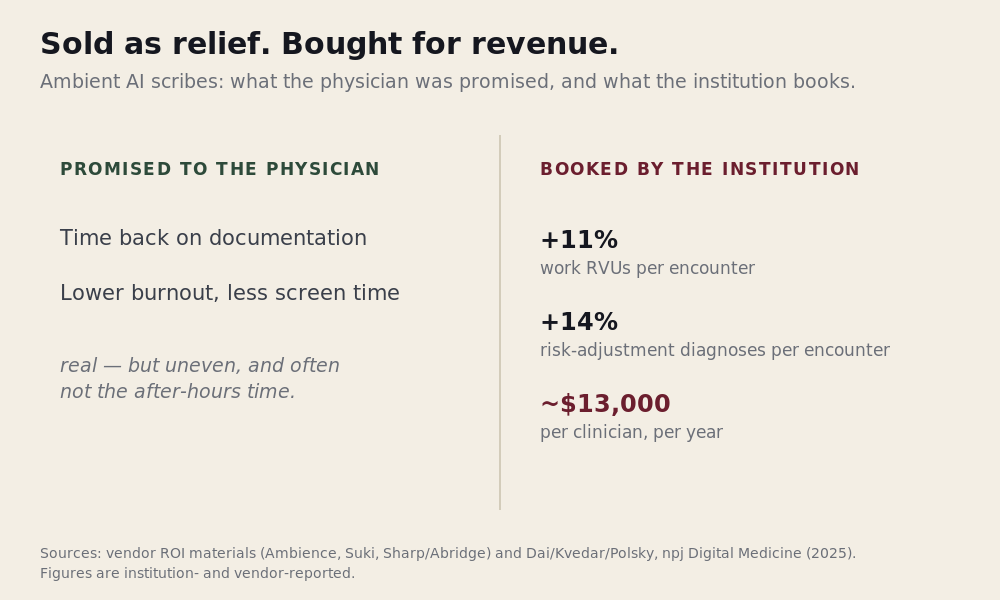
You do not have to take an outside critic’s word for it, because the vendors advertise the revenue logic themselves, in the materials they hand to hospital finance officers. One market leader’s return-on-investment page promises roughly thirteen thousand dollars per clinician per year “via enhanced HCC and greater E/M coding accuracy,” and describes the product as an ambient system for “documentation, coding, and clinical documentation integrity” that “drives revenue-cycle performance.” A competitor’s release reports that its tool lifted level-4 visits by 3.8 percent for a net “$379 per clinician per month” and helps clinicians “capture the full, justifiable complexity of care and significantly reduce revenue leakage.” A large health system, in a case study, reports a 3.5-to-6 percent rise in work RVUs per encounter after rollout; its chief medical informatics officer offers the operative philosophy in a sentence: “If you didn’t write it down, it didn’t happen.” A consultant quoted alongside him is blunter still: “This is all about the bottom line now.”
None of this is hidden, and none of it is, on its face, fraudulent. Documenting the complexity that was genuinely present in a visit is not the same as inventing it. But notice what has happened to the pitch. The evening was the feature. The revenue is the reason.
IV. Not more patients — the same patients, coded higher
The instinctive worry, when a hospital talks about productivity, is that the doctor will simply be made to see more patients — the saved time converted straight into a fuller schedule. That worry turns out to be the wrong one, and the way it is wrong is the most important thing in this essay.
The evidence that scribes let physicians see meaningfully more patients is thin and contested; independent evaluators keep concluding that the throughput gains do not reliably materialize. The single peer-reviewed study to find a productivity effect, from a large academic system, reported that scribe adopters generated about 1.8 more work RVUs per week than non-adopters — a real number, but a small one, and the authors were scrupulous about what they could not say: they could not determine whether the extra RVUs reflected “more clinical services or accurate coding rather than upcoding.” Even the study built to find throughput could not cleanly separate it from coding.
That is because the lever is not the schedule. It is the code. Since 2021 the level of an office visit has been set not by how many boxes of history and exam are checked but by the medical decision-making the visit required and the severity of illness involved — the number and complexity of the problems addressed, the data reviewed, the risk carried by the plan. The same patient, the same twenty minutes, the same medicine — but a note that documents that decision-making and that severity richly enough to support a higher level of service, or to capture an additional risk-adjustment diagnosis that raises a Medicare Advantage plan’s payment. One health system’s published figures show ambient AI lifting work RVUs 11 percent and documented risk-adjustment diagnoses 14 percent per encounter. The productivity does not come from more work. It comes from more thoroughly described work — which is exactly the task an AI that never tires, and never fails to note a comorbidity addressed, a result reviewed, or a risk weighed in the plan, is built to perform.
And here the strongest objection to all of this deserves its full weight, because it is legitimate, and I think it is largely true. For years, physicians left real money uncollected through poor charting. The care was delivered — the comorbidity was managed, the risk was weighed, the complexity was genuinely present — but the note, typed from memory hours later at the end of a brutal day, captured a fraction of it, and payers, who will not pay for what the record does not support, denied claims for work that had actually been done. Under-documentation was its own quiet injustice, and defensive down-coding a rational response to an auditing regime that punished the ambitious note. An ambient scribe that records what was actually said and done, in the room, in real time — rather than what an exhausted physician can reconstruct at ten at night — is not manufacturing complexity. It is recovering complexity that was always real and was being systematically lost. That is a genuine good, and it is the honest case for the coding lift. Grant it in full — I do — and the argument of this essay survives untouched, because the argument was never that the coding is false. It is about who keeps the value the accurate coding recovers.
Now the question a working physician should actually ask: does any of that reach me? Be fair about it — under a pure productivity model, above the threshold, some of a coding lift can flow back to the physician as compensation. But this is the place to run a test on your own contract rather than take my word for it. Look at your incentive plan. Is your pay tied to wRVUs at all, or is it a salary the institution sets? If it is productivity-based, is there a threshold you must clear before any bonus begins — and did you clear it last year? For a great many employed physicians the honest answers are: mostly salaried, and no. In pediatrics especially, where volumes and reimbursement are what they are, most employed physicians never reach the productivity floor at which incremental RVUs start paying them. Which means the coding lift your scribe produced was booked in full by the institution while you sat below the line where it would have become yours. The machine wrote down more; the money the extra writing unlocked went up, not across.
V. Who holds the pen
There is a second asymmetry, and it is sharper than the first, because it concerns risk rather than money.
The AI drafts; the physician signs. And signing is not a formality — it is the assumption of full legal responsibility for a document the physician did not write and may not have read closely. The Federation of State Medical Boards states the rule without ambiguity: physicians “remain fully responsible for the content of all medical documentation, regardless of how it was generated,” and automatic sign-off is discouraged. The American Medical Association has been lobbying to shift AI liability toward the developers “best positioned” to prevent harm — which is itself the tell, because you do not campaign to move a liability that is not currently sitting on you.
And the document cannot be trusted on sight, because the AI can hallucinate — insert content that was never said, and in a clinical note an invented medication is not a rounding error. Fairness and currency both matter here, so it is worth being precise: the alarming rates reported when these tools were new were real for those first-generation models, but they are not the rates today. Newer models have cut hallucination sharply, and what remains varies widely by vendor and by task — raw speech-to-text is far more error-prone than the structured summary built on top of it — in a field that improves month to month. The number is falling, and will keep falling. What does not fall is the structure around it. Whatever the residual rate, it is not zero, and across millions of notes a small fraction is still a real tally of fabricated clinical facts; some early tools erased the source audio after drafting, leaving nothing to check the draft against. And the physician who signs certifies whatever the machine produced as their own — which is exactly why the boards insist review is not optional. The asymmetry holds regardless of the number: the institution keeps the coding revenue; the physician keeps the liability.
Put the two asymmetries together and the shape is familiar to anyone who read the essays that came before this series. The value flows up; the risk stays down. The physician is handed the instrument, told it will give back the evening, and asked to sign for whatever it produces.
VI. Whose intelligence
None of this makes the scribe the villain, and it is worth saying so a final time. It saves real time; the relief is not fake; many physicians are genuinely better off with it than without it, and would tell you so. The point is narrower and more durable than a verdict on the tool. It is that artificial intelligence, dropped into a system, does not distribute its gains evenly. The gains flow to whoever owns the system — who paid for the license, who books the coding revenue, who holds the data — and in almost every case that is not the physician, even when the physician is the one whose work the intelligence was built to perform.
The scribe is only the first and most visible instance, which is why it opens this series rather than closing it. There is a quieter transfer happening in the same exam room, one most physicians have not yet thought to notice: the conversation itself — the physician’s questions, the patient’s answers, the reasoning spoken aloud — is now being captured, at the source, by companies that did not exist in this role five years ago. Where that recording goes, how long it is kept, who is allowed to see it, and who gets to sell what is learned from it, is the subject of the next essay.
For now, the modest, unwelcome question to carry out of the exam room is the one the pitch was designed to keep you from asking. Not did the scribe give me time back — it may well have. The harder one: the value that time unlocked — who, exactly, is keeping it?
Satyanarayan Hegde, MD, is a pediatric pulmonologist and the founder of Access Pediatric.